Solving Iatrogenic Drug Problems At The Wrong End
the police are not the solution to that

We need to stop holding the police tacitly responsible for “mass incarceration.”
One of the most important misdirections in American politics is for the political establishment of both parties insistence on solving the drugs&crime problem at the wrong end, as if it began and ended with problems related to criminal law enforcement, police, and prisons. Because hey, if we're talking an Official Government Response by a law-making body, that's the occupational sector to be focused on, at that End. After the damage has already been done and the cascading problems are being handled (as much as possible, after it's too late) by people careening around with Code 3 sirens on and lights flashing. And then elements of the confused public demand that Official Government Inquiries nit-pick over every exceptional incident of violent policing, when all of the unjustifiable force incidents combined don't add up to the casualty toll of a three day weekend in the same city. "Looking for those dropped keys under the streetlight": the Government exerts Policy control and accountability over policing procedures, so they focus on fixing that. They sure can't threaten the gangs with disciplinary action, can they? Those streets are a gray wall of silence. And those dropped keys are to be found in the Shadow side of Official Government Policy- the Prohibition-enabled illegal drugs economy. But the Lawmakers don't examine their own flawed decisions in relation that situation. Instead, they leave those burdens for the Police to carry. At the back end, after all of the damage has been done, as a result of an illicit market in forbidden substances with currency-like fungibility.
We also need to stop resorting to euphemisms like “mass incarceration”, when the heart of the incarceration problem is and has always been the War On Drugs.
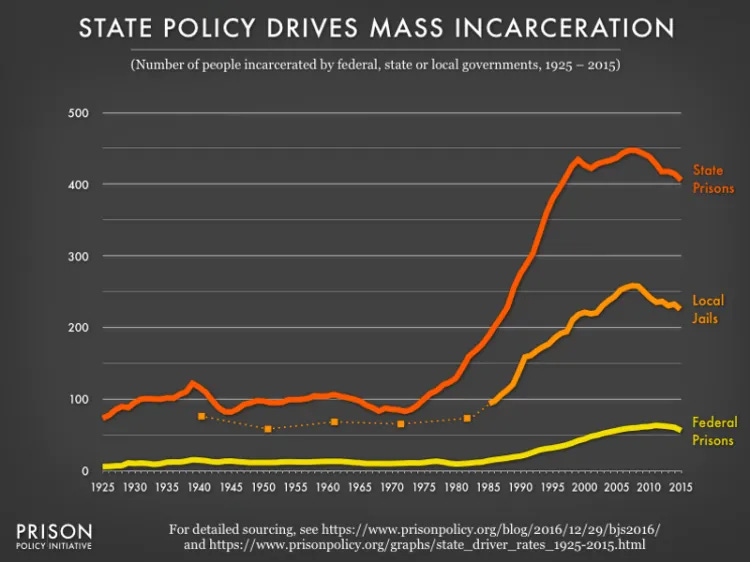
I know, I know: “only 20% of Americans are imprisoned for drug offenses”, or some statistic similarly small in percentage, if not in number. From my reading, everyone asserting that statistic simply stops looking into the illicit drugs economy any further, as if that statistic closed the case: the War On Drugs is not the significant cause it’s said to be, let’s talk about Race instead- most often, with the most hostile and polarized extreme positions dominating the conversation. Or, for the liberals in the middle, the discussion tends to divert toward vague generality that can be finessed with rhetoric.
What’s being ignored are the indirect impacts of the illicit drugs economy; the way that the illicit trade generates other criminal offenses—notably crimes of violence—and the social entropy that results when an underground drug economy becomes a cornerstone source of income- for individuals, families, urban neighborhoods, small towns, rural counties. I’m working on another post to outline some of those impacts, specifically and in more detail.
The problem begins with the legal regime of Prohibition, and the illicit economy that results in a perverse sort of regulatory capture- by organized crime and career criminals. There's an Official Government Response to that situation, too: reforming the Drug Laws. Not to be confused with a Drug User-focused solution a la Decrim or Narcan vending machines. A solution that addresses the corrupting power of the political economy of Drug Dealing. Hundreds of billions of dollars annually. Youth demand for opioids has decreased by 2/3 over the previous 10 years. But this is how far out of hand the supply situation has gotten over the last couple of years: https://kstp.com/kstp-news/top-news/price-of-illicit-fentanyl-drops-to-dangerously-cheap-in-twin-cities-metro/
"In recent months, the price of buying fentanyl on the street in the Twin Cities metro fell to $1-$2 a pill, a longtime narcotics investigator for the Hennepin County Sheriff’s Office confirmed.
That’s down from a roughly $20 price point a couple of years ago, Hennepin County Sheriff’s Major Rick Palaia said, adding that’s still about the cost far outside the metro.
Often, a single pill is more than one dose, meaning a dollar purchase could end in multiple overdoses. The “dangerously cheap” price, Maj. Palaia believes, is exacerbating what has already been a crisis. Although it’s tough to quantify such an impact, he added."
Current price of one illicitly manufactured counterfeit opioid fentanyl pill; $1. Potency uneven from pill to pill, but tending toward strong enough to be a lethal dose. A newbie could conceivably get a serious first opioid high for 25 cents. That indicates a saturation amount of supply, and low demand. Opioids don't have the fad popularity that they had ten years ago. https://adwjeditor.substack.com/p/long-term-trends-in-american-drug
But at 25 cents a pill, someone is going to bite eventually. And since fentanyl is a synthetic opioid, the overhead of manufacture is always going to be low. Given that the dosage range hovers around 1/10 of a milligram. And there are other related substances 100 times as powerful by weight.
"Speaking to the sharp price drop and asked if there’s a similar phenomenon with another illicit opioid to compare it to, Maj. Palaia said, “I’ve never seen anything like this. And I’ve been in this line of work for well over 25 years.”
I've been paying attention for more than 50 years, and I've never seen anything like this. Saturation quantities of ultra-powerful opioids imported and distributed under syndicated crime control nationwide and sold retail at Dollar Store prices- in Minnesota? In 1972, no one could have envisioned that even a science fiction scenario.
The problem of gang-controlled illicit markets has been solved before. The only thing that worked was depriving the bootleggers of their market. It's obviously going to be more complicated in the case of drugs--especially those with a scarily high lethal potential, like refined powder opiates and synthetics. I'd bet that if fentanyl were sold over the counter next to opium tincture, the fentanyl wouldn't sell until the opium was sold out- but I still wouldn't legalize fentanyl. But we're going to have to return to trusting personal adult decisions more. Opium helped to get Lewis and Clark over the Rockies and back in 1804, and it got Richard Burton through an expedition into equatorial Africa.
I never thought that I'd be endorsing the sales of limited weekly amounts of opium to adults with ID. But I never thought that I'd see the day when potentially lethal bootleg fentanyl pills were available on the street for a dollar, either.